At Saarathi Ecosystem, our aim is not to give trading tips or forward ready-made trades. Our focus is to make the science, logic, and technical side behind trading simple and easy to understand.
My focus has always been on Multi-Timeframe Analysis (MTF), or what we can also call the Top-Down Approach. That is why MTF can be seen across most of the tools in the Saarathi Ecosystem.
My simple approach is to use the Major Timeframe for analysis and direction,
and the Minor Timeframe for execution.
There is also a simple thought behind this approach. For me, the Major Timeframe is the Saarathi — Lord Krishna — who shows the direction and guides the way. The Minor Timeframe is the Rathi — Arjuna — who takes action and performs the Karm.
In this article, we will understand what Multi-Timeframe Analysis is, why it matters, how Major and Minor Timeframes work together, and why MTF is the core part of the Saarathi Ecosystem.
Why Do We Need Multi-Timeframe Analysis?
The market is constantly moving, but not every movement has the same importance. A smaller timeframe can show many short-term movements that may look important on their own. Without the bigger picture, it can become difficult to understand whether these movements are part of the main trend or simply temporary activity.
This is why we use Multi-Timeframe Analysis — to connect the bigger picture with the smaller details.
Major Timeframe → Understand the broader market
Minor Timeframe → Understand the smaller movements
By looking at both together, we can build a more structured view of the market instead of reacting to every small movement.
Major Timeframe & Minor Timeframe
In a Multi-Timeframe approach, each timeframe has a specific role.
Major Timeframe is used to study the trend, structure, and overall direction of the market. It gives us the context we need before moving towards execution.
Minor Timeframe is used to observe the smaller price movements and find the right area for execution within the direction identified on the Major Timeframe.
In simple terms:
Major Timeframe → Analysis & Direction
Minor Timeframe → Execution
This is where our Saarathi–Rathi thought fits naturally:
Major Timeframe is the Saarathi — it guides the direction.
Minor Timeframe is the Rathi — it acts on that direction.
Choosing the Execution Timeframe
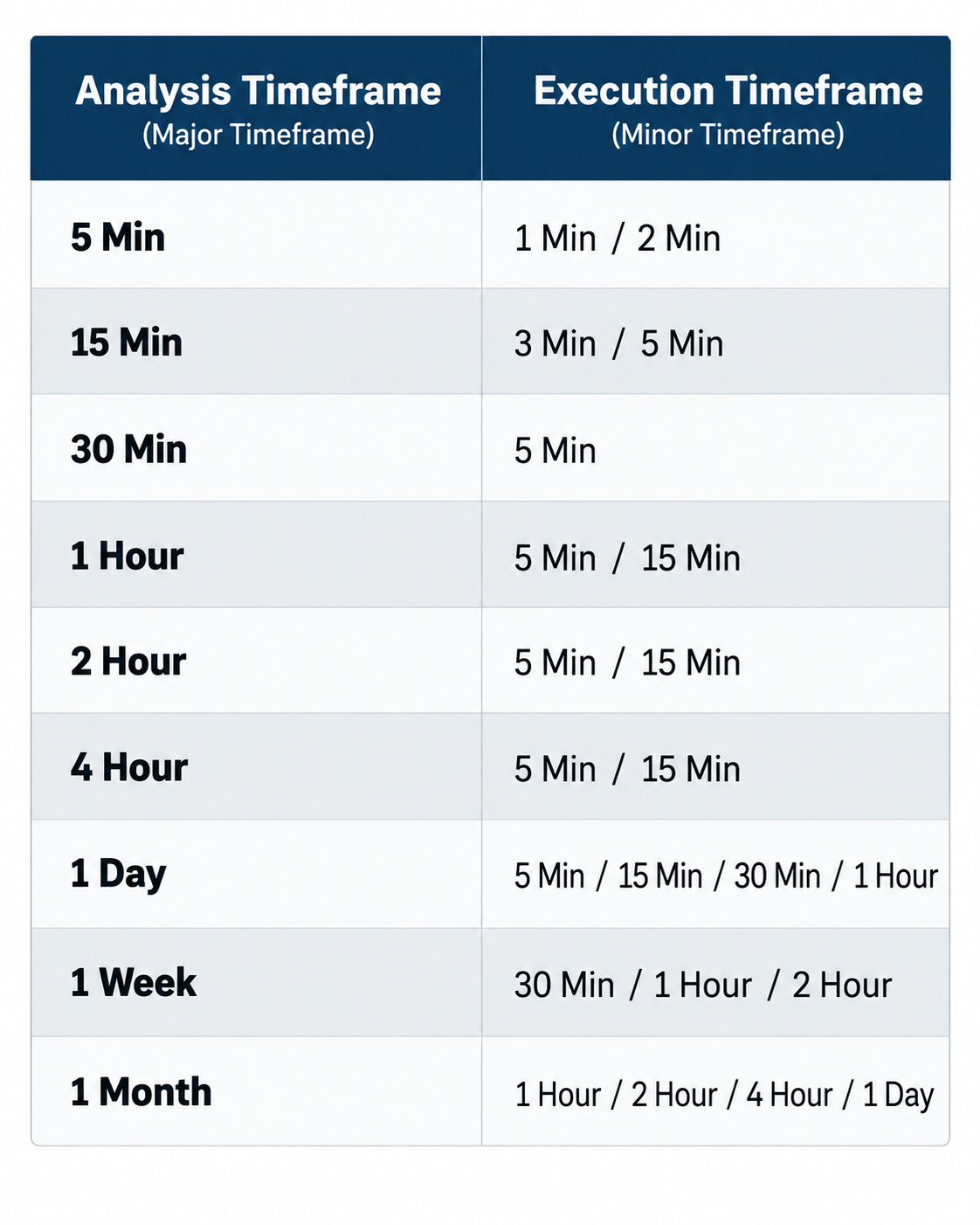
There is no single execution timeframe that works for every analysis timeframe. The basic idea is to keep the execution timeframe smaller than the analysis timeframe, so that we can study the market direction first and then move to a more detailed view for execution.
The table below shows some practical timeframe combinations that can be used as a reference. The exact choice may vary depending on the instrument, market conditions, volatility, and trading style.
Why Start With the Major Timeframe?
Starting with the Major Timeframe helps us understand the broader market context before looking at smaller movements.
It allows us to identify the overall trend, structure, and direction without getting distracted by short-term fluctuations. Once this context is clear, we can move to the Minor Timeframe and focus on execution with a better understanding of the market.
In simple terms:
First understand the direction → Then look for the execution.
This keeps the analysis top-down, structured, and aligned with the broader market context.
Moving From Major to Minor: The Top-Down Approach
The Top-Down Approach means moving from the bigger picture to the smaller details.
We begin with the Major Timeframe to understand the overall trend, structure, and direction. Once the broader context is clear, we gradually move to smaller timeframes to study price activity in more detail and prepare for execution.
A simple flow can be:
Major Timeframe → Trend & Direction
↓
Middle Timeframe → Structure & Activity
↓
Minor Timeframe → Execution
The key is to carry the context from the higher timeframe to the lower timeframe, rather than analysing each timeframe in isolation.
This allows the smaller timeframe to work within the direction and context already established by the Major Timeframe.
A Practical MTF Example
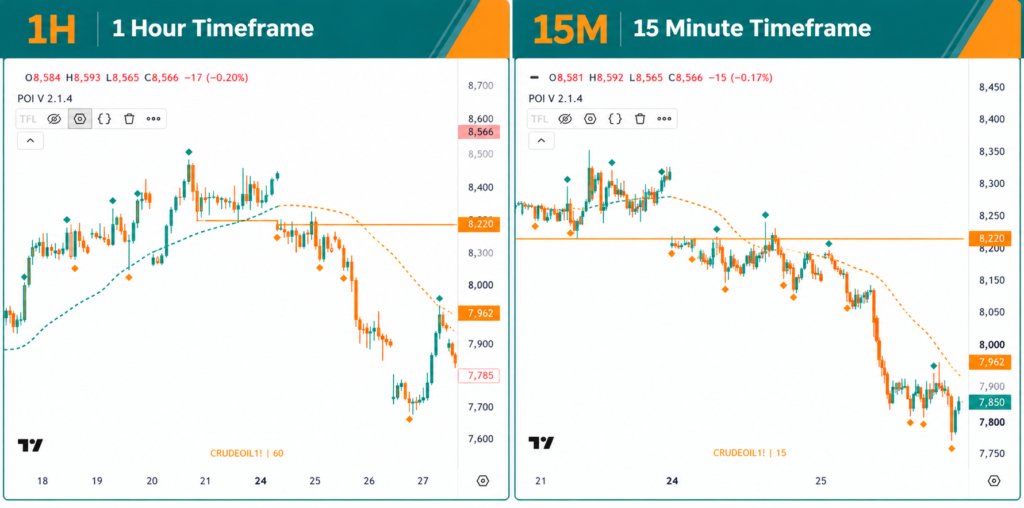
Let us understand this approach with a simple example using the 1 Hour and 15 Minute timeframes.
On the 1 Hour timeframe, a bearish POI is identified and an important level is marked. This gives us the broader context and indicates that the market has developed a potential downside direction.
We then move to the 15 Minute timeframe to look for execution. Here, price breaks below the marked level, moves back towards it, and then continues towards the downside.
This is where the Top-Down approach becomes useful:
1 Hour → Identify the context and direction
15 Minute → Observe the reaction and plan the execution
The important point is that the 15 Minute chart is not analysed in isolation. The execution is planned with the direction and context established by the Major Timeframe.
MTF as the Core of the Saarathi Ecosystem
Multi-Timeframe Analysis is not just a feature in the Saarathi Ecosystem. It is a core part of the way we approach market analysis.
Our tools are designed around the same principle — use the Major Timeframe to understand the market, and the Minor Timeframe to work towards execution.
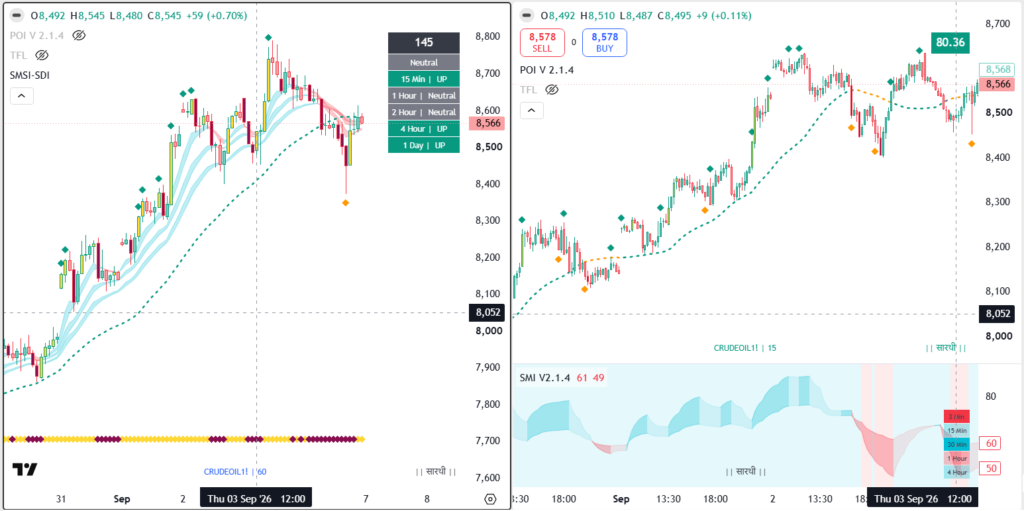
For example, SMSI includes an MTF Dashboard that allows us to see the status of multiple timeframes in one place. POI follows the same approach, where a POI can be identified on the Major Timeframe and then used as a reference for execution on a smaller timeframe. SMI V2.1.4 (Saarathi Momentum Index) also incorporates the MTF approach, with its dashboard helping us understand the momentum status across different timeframes and build a directional bias from the Major Timeframe.
One framework, different tools — but the core remains the same:
Analyse from the top, then move down towards execution.
MTF Is a Framework, Not a Trade Signal
Multi-Timeframe Analysis is a way of organising market information, not a system that directly tells us when to buy or sell.
The purpose of using different timeframes is to understand the market in layers. The Major Timeframe helps us understand the broader trend, structure, and direction, while the Minor Timeframe helps us study the smaller movements and look for possible execution opportunities.
This means that simply seeing a bullish or bearish condition on a higher timeframe does not mean that a trade should be taken immediately. It only gives us a context and directional reference.
Similarly, a movement on the Minor Timeframe should not be treated as an independent trade signal. It needs to be understood in the context of what the Major Timeframe is showing.
Think of MTF as a Decision Framework
A simple way to look at it is:
Major Timeframe → What is the broader market doing?
Minor Timeframe → How is price behaving within that context?
Execution → Is there a valid opportunity according to your own trading plan?
This separation is important because analysis and execution are two different tasks.
Our Saarathi tools are built to help with different parts of this process. They can help us understand direction, momentum, price activity, structure, and timeframe context, but they do not replace a complete trading plan.
The final decision still depends on factors such as setup, risk management, position sizing, market conditions, and execution rules.
So, the purpose of MTF is not to predict every market movement.
It is to help us understand the market from the bigger picture to the smaller details — and make decisions with context rather than reacting to every movement.
Conclusion — Analyse First, Execute With Context
Multi-Timeframe Analysis gives us a simple way to look at the market from the bigger picture to the smaller details. Start with the Major Timeframe to understand the direction and context. Then move to the Minor Timeframe to study the price activity and plan the execution.
This is the core idea behind our approach:
Analyse First → Understand the Direction → Move Down → Execute With Context
For us, MTF is not about adding more charts or more complexity. It is about giving each timeframe a clear role.
This is also the thinking behind the Saarathi Ecosystem — helping traders understand the market in a more structured, simple, and logical way, rather than simply following trade signals.
The Major Timeframe guides.
The Minor Timeframe executes.
Analyse from the top. Execute with context.
Thank You
Thank you for taking the time to explore Multi-Timeframe Analysis and
the thinking behind the Saarathi Ecosystem.
We hope this framework helps you look at the market with more clarity, structure, and context — starting from the bigger picture and gradually moving towards execution.
The goal is not to make trading more complicated, but to develop a simple and logical
way of reading the market across timeframes.
Analyse with context. Execute with discipline. Keep learning.
— Team Saarathi Analytics